
Quantum Breakthrough Could Transform Heart Disease Diagnosis in Australia
09 Dec, 2025
Recent News
- Reshaping How Scientists Explore the Physical Behaviour of Living Systems
- Scientia Professor Michelle Simmons AC appointed Companion of the Order of Australia
- Quantum meets neuroscience in the fight against MND
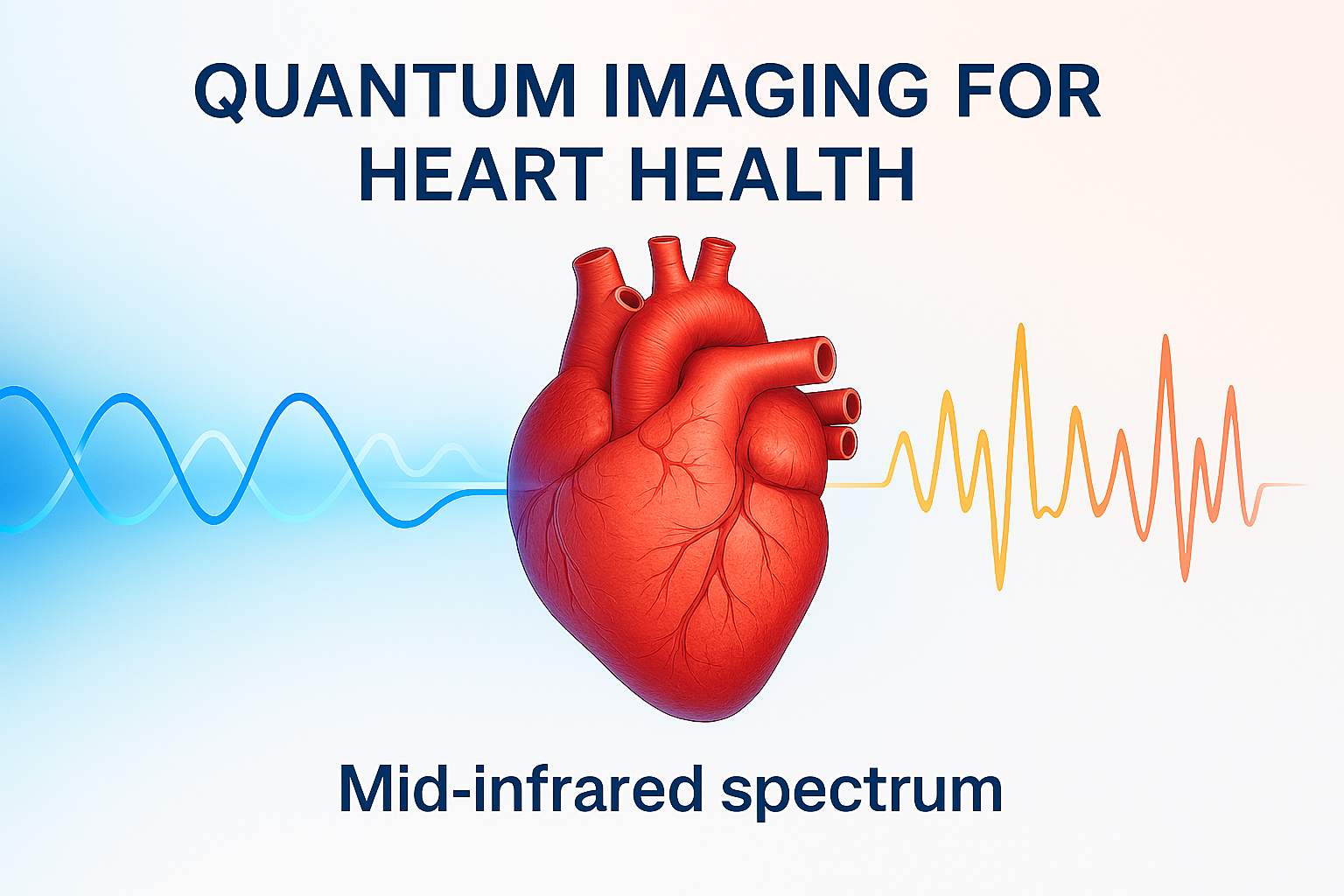
Heart disease remains the leading cause of death worldwide, and early, accurate diagnosis is critical to saving lives. Researchers at the ARC Centre of Excellence in Quantum Biotechnology (QUBIC) have taken a major step toward that goal by developing a quantum mid-infrared imaging approach that shows promise for distinguishing healthy from diseased heart tissue at the molecular level. This achievement, delivered through the Australian Government’s $36 million Critical Technology Challenge Program (CTCP), moves the technology closer to real-world use and positions Australia at the forefront of quantum-enabled health innovation.
The project demonstrates how quantum technologies can provide precise, non-invasive insights into heart health, paving the way for faster and more accurate diagnosis. It also marks progress toward prototype development, advancing beyond laboratory validation.
“By showing that quantum mid-infrared imaging can identify disease signatures in heart tissue, we’ve opened a pathway to practical diagnostic tools that could transform cardiovascular care,” says Professor Irina Kabakova, project lead at the University of Technology Sydney.
How the Technology Works
Infrared light can reveal the unique “fingerprints” of molecules because proteins, lipids, and other biomolecules absorb light at specific wavelengths. The mid-infrared range is particularly powerful for detecting these vibrational signatures, which change when tissue becomes diseased. QUBIC’s approach uses quantum-generated entangled photons to probe samples with high sensitivity and without dyes or labels. This enables label-free imaging and spectroscopy that can detect subtle molecular changes in tissue, such as those linked to heart disease, potentially allowing earlier and more accurate diagnosis.
The work is led by a cross-disciplinary team at UTS, including Professor Irina Kabakova, an expert in optical biomedical systems; Professor Alexander Solntsev, a leader in quantum optics and photonics; A/Prof Lana McClements, an expert in cardiovascular health, and Dr Isa Ahmadalidokht, who specialises in quantum spectroscopy and microscopy for diagnostics. Their combined expertise is enabling the transition from fundamental research toward applied health technology.
About the Critical Technology Challenge Program
The Critical Technology Challenge Program is a $36 million initiative under Australia’s National Quantum Strategy, designed to accelerate commercialisation of quantum technologies by moving them from early-stage readiness toward deployment and adoption. Round 1 Challenges included improving medical imaging and sensors for disease diagnosis, aligning directly with QUBIC’s heart disease spectroscopy project.
Bringing quantum to life
Quantum technologies are unlocking new frontiers in drug discovery, biomedical imaging, neuroscience and clean energy. Global investment in quantum technologies has already exceeded $55 billion, with the market projected to reach $106 billion by 2040. Life sciences are emerging as one of the most promising application areas, with quantum computing alone estimated to create $200–$500 billion in value by 2035, particularly through breakthroughs in drug discovery, diagnostics, and molecular simulation.
About QUBIC
The ARC Centre of Excellence in Quantum Biotechnology (QUBIC) is the world’s first national centre at the intersection of quantum science and biotechnology. QUBIC is developing next-generation quantum tools – including brain imagers and single-protein sensors – to tackle major challenges in health, biosecurity, energy, and agriculture. QUBIC’s research institutions include the University of Technology Sydney, University of Wollongong, The University of Queensland, the University of Melbourne, and Flinders University, and partners with leading industry, government, and international institutions.