
Unlocking the Hidden Brain with Quantum Technology: A New Era of Brain Measurement
19 Jul, 2026
Recent News
- Summer Undergrad Internships NOW OPEN
- Four teams awarded seed funding to advance quantum biotechnology research
- QUBIC takes quantum biotechnology across Australia for National Science Week 2026
When Curiosity Meets Brain Science

When Sophie Lin talks about the brain, her tone is equal parts wonder and humility. “The more you study the brain, the less you feel like you really understand it,” she says – a line that neatly captures both her scientific motivation and her career path. Trained originally as a neurologist, she encountered a gap between what brain images indicated and what patients with epilepsy, stroke, and degenerative diseases experienced. The brain imaging story didn’t quite add up. So she crossed the bridge into academia, determined to ask deeper questions about how the brain actually works.
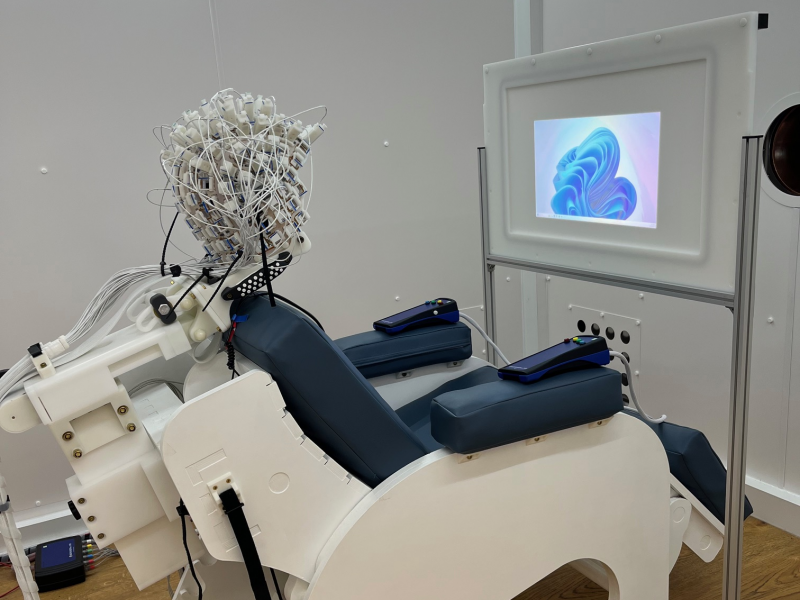
Today, Sophie manages the optically pumped magnetoencephalography (OP-MEG) facility at the University of Melbourne – Australia’s first whole-head, wearable imaging system of its kind – and is part of a broader effort to use quantum sensing technologies to image biological systems in new and more precise ways. Her focus is a part of the brain that has long been overlooked: the cerebellum.
The Hidden Brain
The cerebellum sits at the bottom of the brain – tucked away, hard to reach, and even harder to measure. The magnetic signals the brain emits are billions of times weaker than the Earth’s magnetic field – it’s like trying to hear a whisper in the middle of a stadium concert. For a long time, the cerebellum was thought of as a supporting actor, mainly associated with movement and coordination. Increasingly, patient data and neuroscience studies suggest it plays a much more important role, including in language, learning, and higher-order cognition. But to understand what it really does, researchers first need a reliable way to observe it in action.
For most of modern neuroscience, that has been the hard part. Traditional MEG systems rely on sensors that must be cooled to extremely low temperatures and housed in large, rigid, shielded rooms. The hardware sits several centimetres away from the scalp, which limits sensitivity – especially for deeper brain structures like the cerebellum.
The result has been a neuroscience blind spot. In clinical practice, Sophie saw the consequences of that gap firsthand: patients whose symptoms could not be cleanly explained by what standard imaging showed. As she puts it, structure alone does not always tell you how the brain is functioning in real time.
For years, the implicit conclusion was simple: measuring cerebellar activity non-invasively is too difficult to do well. That assumption is now being challenged by a new class of quantum sensors – and that could lead to a better understanding of neurodegenerative diseases, stroke recovery, and epilepsy.
Enter Quantum Sensors
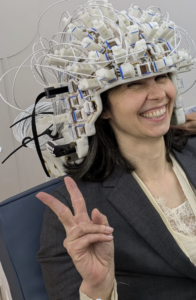
OP-MEG uses optically pumped magnetometers – quantum sensors that operate at room temperature. Instead of being locked into a fixed helmet inside a bulky cryogenic system the size of a refrigerator, these sensors can be placed directly on the head, in a lightweight, wearable array. For researchers like Sophie, that significantly improves what is possible in neuroscience imaging.
This proximity matters. By bringing the sensors much closer to the scalp, OP-MEG can capture brain signals that are two to three times stronger than those measured by conventional systems. The sensors are mounted in a wearable helmet that can be customised from an individual’s MRI scan, allowing researchers to position sensors closer to regions of interest such as the cerebellum. This personalised design also makes scanning more accessible – enabling studies with children or elderly participants who may struggle to remain completely still.
In Sophie’s work, this quantum sensing platform is doing something radical: it is giving the cerebellum “another chance” to be studied properly. This is not about a single disease or a single experiment. It is about building a new measurement capability – a platform technology that lets researchers observe parts of the brain that have been, until now, largely hidden.
This is quantum technology in action: not just a laboratory curiosity, but a tool that changes what can be measured, who can be measured, and what questions can be asked – building on decades of animal research to show that wearable quantum sensors can now detect cerebellar activity in humans.
From Discovery to Helping People Speak Again
The implications of this new window on the brain are wide-ranging. Better access to cerebellar signals could deepen understanding of conditions such as stroke, alcohol-related brain damage, neurodegenerative disorders, and psychiatric disorders. It could reshape how scientists think about sleep, learning, and even consciousness. Increasingly, evidence suggests the cerebellum is involved in far more than movement – but without the right tools, those hypotheses have been difficult to test.
One of Sophie’s current directions is exploring how the cerebellum contributes to language and speech production. If researchers can identify reliable neural markers linked to how the brain produces language, those signals could one day be used to build more advanced, brain-informed speech assistance technologies for people who struggle to speak because of neurological conditions.
By turning the cerebellum from a blind spot into a field of discovery, OP-MEG is expanding what brain science can do, and showing how Australia’s quantum capability can translate into tools that change how we explore the most complex system we know: the human brain.
visit the Cognitive Neuroscience and Computational Psychiatry Laboratory
visit the Melbourne Brain Centre Imaging Unit (MBCIU)