
Queensland’s Quantum and Life Sciences Communities Come Together to Explore Drug Discovery Collaborations
05 May, 2026
Recent News
- QUBIC strengthens quantum diamond ecosystem through new Melbourne hub
- Summer Undergrad Internships NOW OPEN
- Four teams awarded seed funding to advance quantum biotechnology research
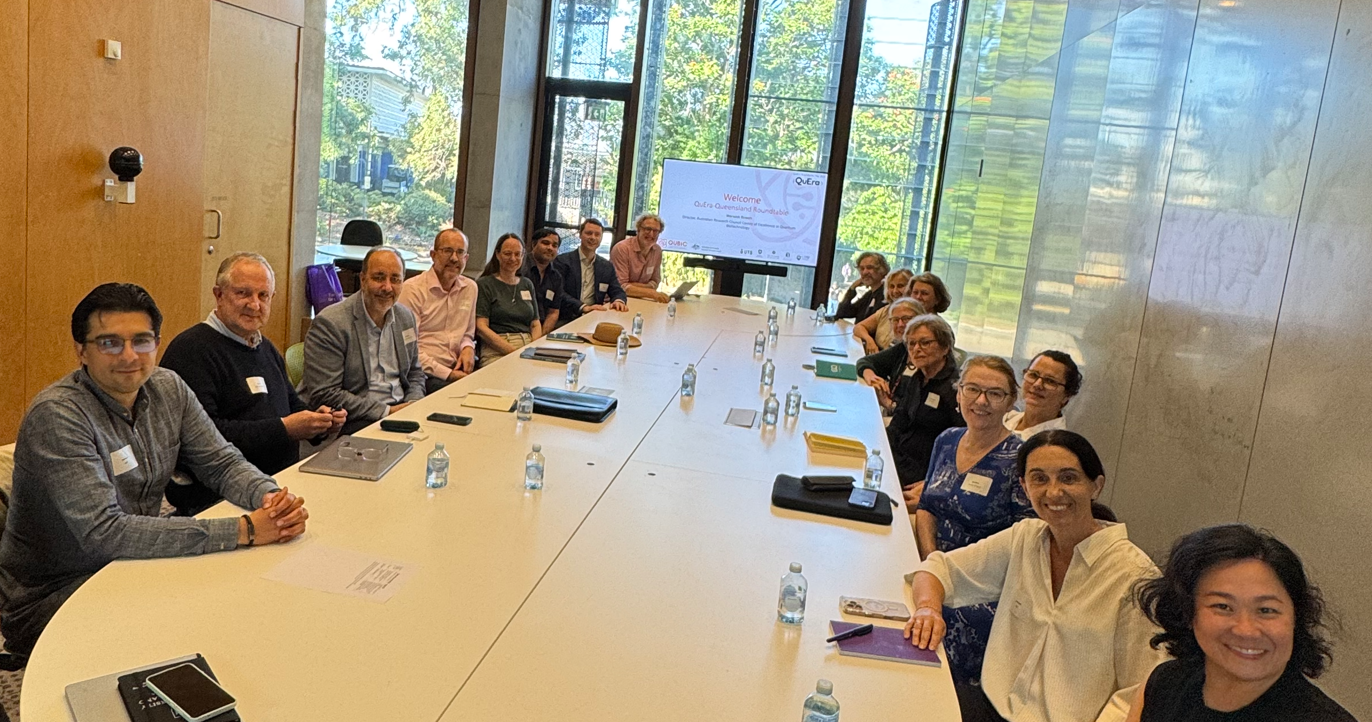
On Friday 1 May, QUBIC hosted a roundtable bringing together researchers, industry partners, and government representatives to explore how quantum computing could accelerate drug discovery and life sciences research in Queensland and beyond.
The event, held at the Global Change Institute Building at The University of Queensland, was convened in partnership with QuEra Computing Inc. — a global leader in neutral-atom quantum computing with a growing portfolio of pharmaceutical and biomedical research collaborations. Attendees represented a cross-section of Queensland’s quantum ecosystem, including researchers from the University of Queensland and Griffith University, representatives from Queensland Government’s Department of the Environment, Tourism, Science and Innovation (DETSI), and industry partners including Sanofi and IBM.
The session was designed to surface shared research interests and identify concrete pathways for collaboration at the intersection of quantum computing and life sciences — from molecular simulation and reaction dynamics to drug discovery pipelines and antimicrobial resistance.
QUBIC Director Professor Warwick Bowen reflected on the quality of the discussion: “It was a pleasure to host the roundtable between QuEra and the Queensland quantum algorithms, molecular simulations and pharma communities. I think we established a strong base on which to build meaningful collaborations.”
Tommaso Macri, Senior Director of Business Development at QuEra Computing Inc., noted the depth of the technical exchange: “What stood out was how concrete the conversation became. The group quickly moved toward specific scientific problems in molecular simulation, reaction dynamics, and drug discovery. They discussed where current methods fall short and explored where QuEra’s capabilities in neutral-atom quantum simulation, error-corrected systems, and application co-design could add value. That is the kind of grounded dialogue we need to identify collaborations worth pursuing.”
For Helen Burns of IBM, the energy in the room was equally striking: “The highlight was seeing the desire from industry, the state sector, and the academic community to close the gap between what was unknown in science and what could be explored through quantum computing — and the desire to keep talking and learning about deep pockets of scientific expertise and the possibilities quantum computing offers.”
The roundtable marks the beginning of an ongoing collaborative process to work towards identifying high-impact problems in pharmaceutical research where quantum computing can deliver a meaningful advantage — and to map the partnerships and funding mechanisms needed to pursue them.