Four teams awarded seed funding to advance quantum biotechnology research
01 Sep, 2026
Recent News
- QUBIC strengthens quantum diamond ecosystem through new Melbourne hub
- Summer Undergrad Internships NOW OPEN
- Four teams awarded seed funding to advance quantum biotechnology research
New collaborations formed through QUBIC’s Cell Research Theme are helping lay the groundwork for future advances in health and biomedical research, with four interdisciplinary teams awarded seed funding to pursue innovative projects spanning cancer biology, cellular imaging and quantum sensing.
Understanding how cells function, communicate and respond to their environment is at the centre of the theme. Bringing together expertise in quantum science, microscopy, cell biology and biomedical research, the theme is developing advanced imaging and sensing technologies to investigate cellular behaviour with unprecedented sensitivity and resolution. The research aims to reveal the molecular and mechanical processes that underpin life at the cellular level.
But unlocking the full potential of these emerging technologies requires more than technical innovation. It depends on researchers from different disciplines, institutions and backgrounds coming together to share expertise, build new collaborations and develop ambitious ideas.
To help foster these connections, the theme launched its inaugural seed funding initiative, supporting four collaborative pilot projects designed to stimulate new multidisciplinary partnerships across QUBIC and generate early-stage data for future research opportunities.
The funded projects bring together researchers from across The University of Queensland, the University of Technology Sydney and The University of Melbourne, combining expertise in quantum imaging, microscopy, cancer biology, cellular mechanics and extracellular vesicle research.
Cell Theme Lead Dr Elizabeth Hinde said the seed funding initiative was designed to encourage new collaborations and support early-stage ideas with the potential to open new research directions.
“One of the most exciting outcomes of the workshop was seeing researchers from different disciplines and institutions come together to develop innovative project ideas that combine emerging quantum technologies with important biological questions.”
“Several of the winning proposals were led by early career researchers and PhD students, which is particularly exciting. The seed funding will help these teams establish new collaborations and generate preliminary data, with their first results to be shared at the QUBIC Annual Symposium later this year.”
Four projects awarded seed funding
RheoSome: simultaneous kinetic-rheologic measurements of endosomal escape using RheoSCAT imaging
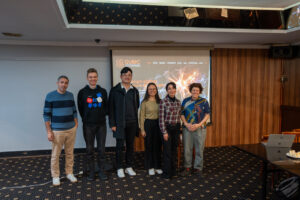
The first funded project, RheoSome, brings together PhD students Charlie Gray, Dan Lei, Jackson Lucas and Kyle Clunies-Ross from the Queensland Quantum Optics Laboratory at The University of Queensland with PhD student Vrushali Maste from the Protein Trafficking and Inflammation Laboratory at the Institute for Molecular Bioscience. The team will investigate endosomal escape using RheoSCAT imaging, combining kinetic and rheological measurements to better understand this important cellular process.
Quantum mid-IR microscopy of lipid heterogeneity
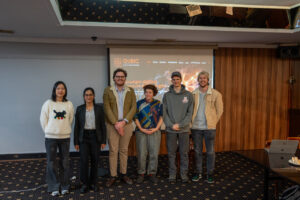
Led by Professor Alexander Solntsev (UTS), together with Irina Kabakova (UTS) and Jennifer Stow (UQ), this project will test the potential of quantum mid-infrared imaging to provide label-free lipid contrast in three-dimensional breast cancer models. The work will explore how quantum imaging approaches could be applied to visualise lipid heterogeneity within complex biological systems.
Extracting Extracellular Vesicles for Quantum Imaging using peptide-conjugated magnetic beads
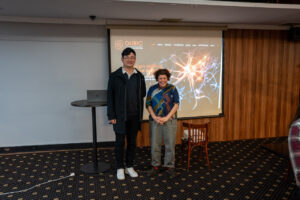
Hongyu Shen and Dr Mina Barzegaramiriolya (UQ/University of Melbourne), working with Chief Investigators Jennifer Stow and David Simpson (UoM), will develop a new approach for isolating cancer-derived extracellular vesicles using peptide-conjugated magnetic beads. The project aims to establish a tool that could support future studies of extracellular vesicles using advanced quantum imaging techniques.
Leveraging Brillouin microscopy to visualise structural properties of 3D cell culture
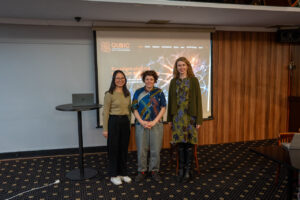
The fourth funded project is led by Sylvia Jin Hui Tan (UQ/UTS), together with Chief Investigators Jennifer Stow and Irina Kabakova. The team will use Brillouin microscopy to investigate the structural and biomechanical properties of three-dimensional cell culture models, including breast cancer spheroids and pseudo-vessels.
Building the expertise for future quantum biotechnology applications
The four funded teams will present their progress and findings at the QUBIC Annual Symposium in November, showcasing the outcomes of the Centre’s newest collaborations and the potential these projects hold for future Cell Theme research.
Read more about QUBIC’s Cell Research Theme.
Images: Recipients of the winning project teams with Dr Elizabth Hinde, Cell Theme Lead.