Submissions are open for the MTD Portfolio’s Industry Collaboration Internship.
Find out more here

Molecules Theme: https://events.humanitix.com/molecule-workshop-2026
Cell Theme: https://events.humanitix.com/cells-workshop-2026
Brain Theme: https://events.humanitix.com/brain-theme-workshop
EMCR Winter School: https://events.humanitix.com/emcr-winter-school-2026
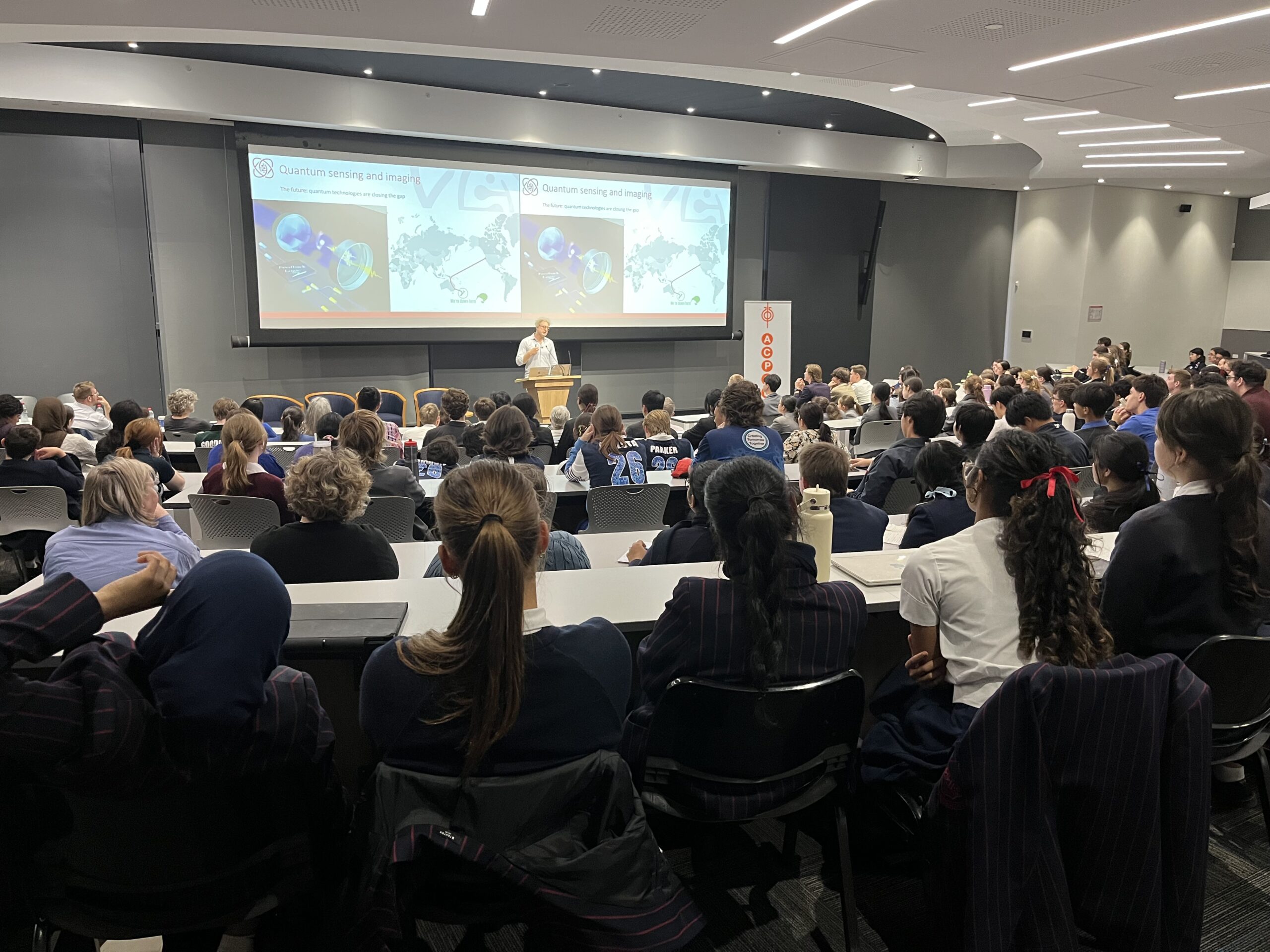
Centre Director Professor Warwick Bowen took to the stage at the annual Churchie Physics Lecture to explore how quantum technologies are poised to transform medicine — and why that future is closer than most people think.
On 12 May, around 300 high school students from across Brisbane gathered at Anglican Church Grammar School (Churchie) for the school’s annual Physics Lecture. This year’s keynote was delivered by QUBIC’s Director, Professor Warwick Bowen, whose talk — How quantum is set to change medicine — traced the journey from the fundamental strangeness of quantum mechanics to its growing role in medical imaging, drug discovery, and brain science.
Warwick opened by grounding students in Quantum 1.0: the first revolution in quantum understanding that already underpins technologies many take for granted — from MRI and PET scans to magnetoencephalography. He then turned to Quantum 2.0, the era we’re now entering, in which scientists are actively engineering quantum phenomena to do things classical technology simply cannot.
“These students are going to inherit a world shaped by quantum technology — and most of them don’t know it yet. If even a few of them walk away wanting to understand the physics behind an MRI machine, or curious about what a quantum computer could mean for drug development, then the evening did exactly what it should.”
— Professor Warwick Bowen, Director, QUBIC
The lecture drew on QUBIC’s three grand challenges: imaging and modelling individual protein molecules in real time, understanding how cell-scale behaviour emerges from molecular interactions, and achieving whole-brain electromagnetic imaging at single-neuron resolution. Warwick illustrated each with concrete examples — from the exponential complexity that makes molecules so hard to simulate, to quantum diamond microscopes and the prospect of next-generation brain scanners affordable enough to reach regional hospitals.
The evening was a strong success. Warwick noted enthusiastic engagement throughout, with students asking questions that reflected genuine curiosity about both the science and its real-world stakes. Elizabeth Jenkins, Head of Physics at Churchie, echoed that sentiment in a note to the Centre afterwards, describing the evening as something students “value enormously” and extending an open invitation for QUBIC to return.
Outreach events like this one are central to QUBIC’s mission — bringing the science of quantum biotechnology out of the lab and into the broader community, and helping the next generation of students see themselves as part of that story.
Quantum assays for anti-doping control
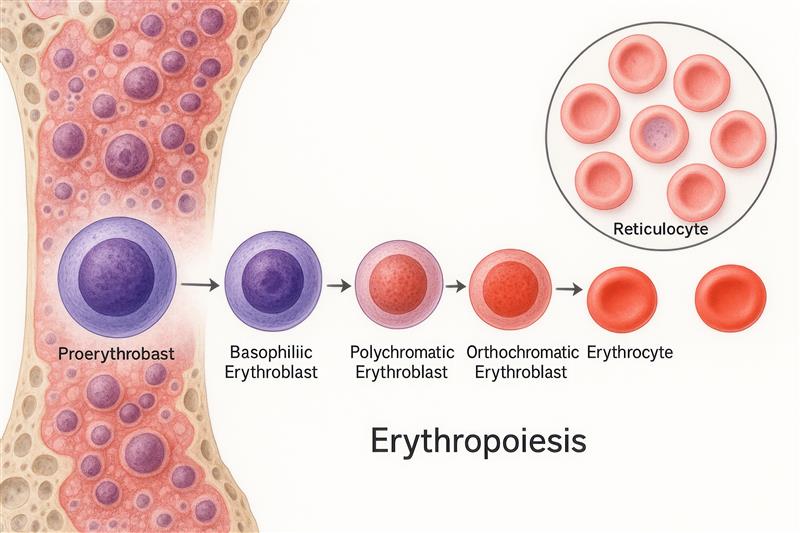
Erythropoietin (EPO) is a natural hormone that stimulates red-blood-cell production. Synthetic EPO closely mimics the natural form, making it hard to detect quickly and at low concentrations when misused for illegal doping. Current, lab-bound methods are slow and complex, creating a need for faster, more sensitive, field-ready tests.
A quantum photonic lab-on-a-chip that traps and analyses single EPO molecules, measuring mass, electrical charge and a vibrational fingerprint to tell natural from synthetic EPO. Combining these readouts aims to improve speed and sensitivity, potentially suitable for real-world, trackside testing.
A QUBIC research team at the University of Queensland is developing and validating an integrated chip that optically traps proteins to provide label-free molecular fingerprinting of EPO at very low concentrations. “We start with known samples, set calibration, confirm specificity and detection limits, build and trial a prototype chip for anti-doping workflows,” says researcher Dr Igor Marinkovic.
“Direct molecular fingerprinting could redefine how EPO doping is detected,” says Dr Pavlina Naydenova. “Quantum photonic chips promise faster, more sensitive and selective testing, giving sporting bodies and clinicians a powerful new tool to safeguard athlete health and ensure competition integrity.”
Funded by the Queensland Government’s Quantum 2032 Challenge
Meeting net-zero commitments will require faster, deeper innovation across energy, materials and industrial systems — and many of the hardest decarbonisation problems now sit beyond the limits of today’s tools. The Queensland Quantum Decarbonisation Alliance was established to change that, bringing quantum capability to the places where conventional approaches fall short.
As the Alliance accelerates from establishment to delivery, the $30 million initiative has appointed its inaugural leadership team.
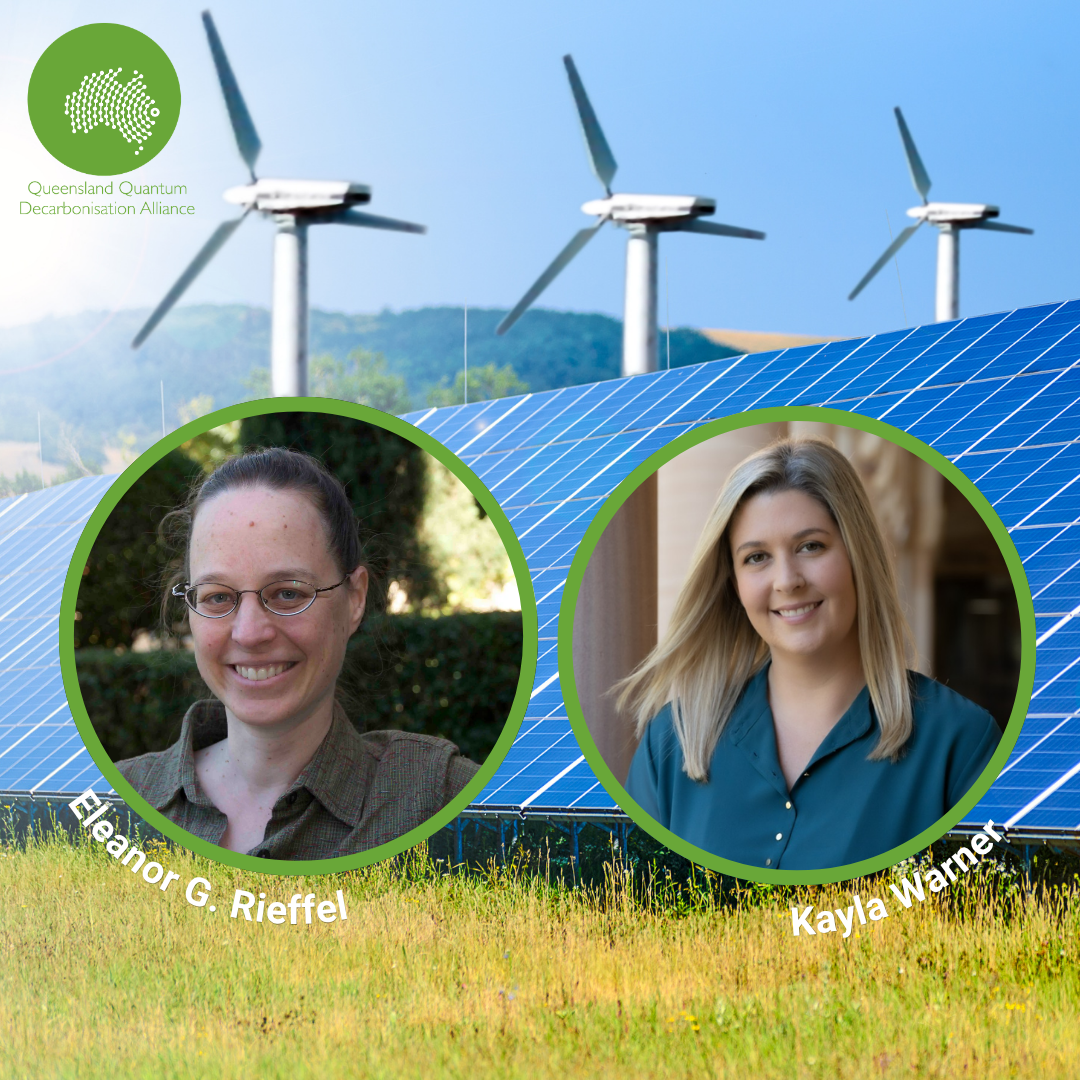
Prof. Eleanor G. Rieffel joins as Director, and Kayla Warner as Manager — formalising the leadership of a 27-partner consortium built to apply quantum technologies to one of the defining challenges of our time.
The QDA was established through QUBIC, alongside core partners the University of Queensland, Griffith University, PsiQuantum, and CSIRO — part of a broader 27-partner consortium. The partners span quantum science, decarbonisation research and carbon‑intensive industry including Siemens, Aurizon and Energy Queensland, creating a structure that connects frontier capability with real‑world need.
Prof. Warwick Bowen, Director of QUBIC, has spent the past 18 months working with partners to establish the Alliance, secure funding and build the consortium, before handing over to the incoming leadership team. QUBIC remains a core research partner in the Alliance’s work.
“Some of the most persistent decarbonisation challenges now sit beyond the limits of classical computing and sensing. Quantum technologies open new opportunities, and Australia is well placed to translate this capability into real world impact. The QDA was set up to do just that at scale and Eleanor and Kayla bring the right combination of technical depth, leadership and partnership experience to take the Alliance from foundation to delivery.”
— Prof. Warwick Bowen, Director, QUBIC
Prof. Rieffel arrives from NASA’s Ames Research Center, where she led the Quantum Artificial Intelligence Laboratory (QuAIL) and served as NASA Senior Researcher for Advanced Computing and Data Analytics. One of the world’s leading experts in making quantum computers practically useful, her research spans quantum algorithms, quantum error correction, logical and fault-tolerant architectures, and resource estimation for future real-world applications of quantum technologies. She is the co-author, with Wolfgang Polak, of Quantum Computing: A Gentle Introduction (MIT Press, 2011) — one of the most widely read introductions to the field.
“The vision propelling my work is to see quantum computers enhance the world by solving high-impact computational problems of societal value. As director of the Queensland Quantum Decarbonisation Alliance, I look forward to inspiring others, both students just starting their careers and established researchers in other fields who are curious about quantum computing, to contribute to this fascinating field. I’m excited to build on the already strong foundation of quantum science in Queensland to deepen the research around and the practical impact of this emerging technology.”
— Prof. Eleanor Rieffel, Director, Queensland Quantum Decarbonisation Alliance
Kayla joins from UQ’s Global Partnerships team, where she built international partnerships across North America, Latin America, and the Pacific. She brings deep experience working at the intersection of research, industry, and government across the energy transition, critical minerals, health, education, and advanced technology sectors.
“Joining an alliance at this stage — when the strategy, partnerships and operating model are still being built — is a rare opportunity. There’s a lot of work ahead, but the foundations are exceptional. The ambition is significant, and the foundations are strong. I’m here to help translate that ambition into high‑impact partnerships and outcomes that genuinely accelerate decarbonisation.”
— Kayla Warner, Manager, Queensland Quantum Decarbonisation Alliance
Prof. Eleanor G. Rieffel and Kayla Warner hit the ground running with the QDA’s first upskilling event on Thursday 7 May at Customs House, Brisbane — bringing together industry, government, and research professionals for a half-day of practical tutorials on quantum sensing and quantum computing, delivered by experts from QUBIC, Griffith University, and PsiQuantum.
More information about the QDA, its research program, and its 27 partner organisations is available here.
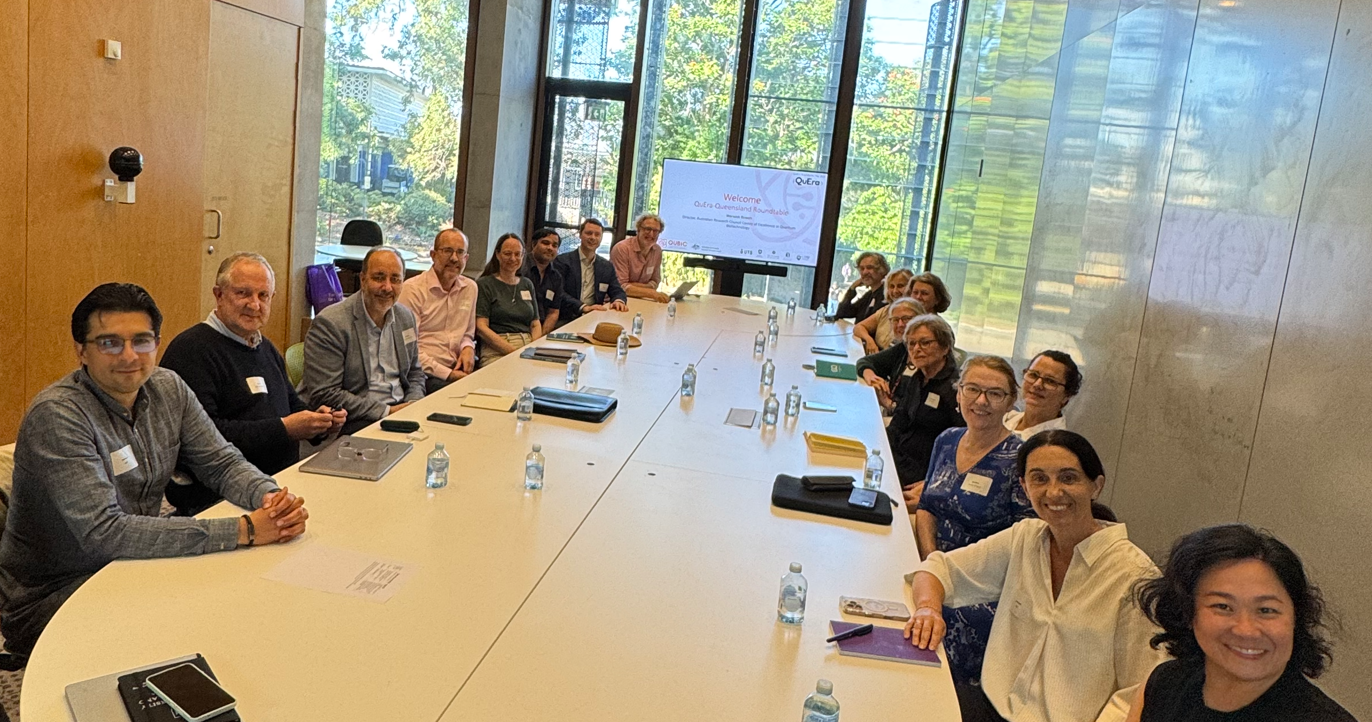
On Friday 1 May, QUBIC hosted a roundtable bringing together researchers, industry partners, and government representatives to explore how quantum computing could accelerate drug discovery and life sciences research in Queensland and beyond.
The event, held at the Global Change Institute Building at The University of Queensland, was convened in partnership with QuEra Computing Inc. — a global leader in neutral-atom quantum computing with a growing portfolio of pharmaceutical and biomedical research collaborations. Attendees represented a cross-section of Queensland’s quantum ecosystem, including researchers from the University of Queensland and Griffith University, representatives from Queensland Government’s Department of the Environment, Tourism, Science and Innovation (DETSI), and industry partners including Sanofi and IBM.
The session was designed to surface shared research interests and identify concrete pathways for collaboration at the intersection of quantum computing and life sciences — from molecular simulation and reaction dynamics to drug discovery pipelines and antimicrobial resistance.
QUBIC Director Professor Warwick Bowen reflected on the quality of the discussion: “It was a pleasure to host the roundtable between QuEra and the Queensland quantum algorithms, molecular simulations and pharma communities. I think we established a strong base on which to build meaningful collaborations.”
Tommaso Macri, Senior Director of Business Development at QuEra Computing Inc., noted the depth of the technical exchange: “What stood out was how concrete the conversation became. The group quickly moved toward specific scientific problems in molecular simulation, reaction dynamics, and drug discovery. They discussed where current methods fall short and explored where QuEra’s capabilities in neutral-atom quantum simulation, error-corrected systems, and application co-design could add value. That is the kind of grounded dialogue we need to identify collaborations worth pursuing.”
For Helen Burns of IBM, the energy in the room was equally striking: “The highlight was seeing the desire from industry, the state sector, and the academic community to close the gap between what was unknown in science and what could be explored through quantum computing — and the desire to keep talking and learning about deep pockets of scientific expertise and the possibilities quantum computing offers.”
The roundtable marks the beginning of an ongoing collaborative process to work towards identifying high-impact problems in pharmaceutical research where quantum computing can deliver a meaningful advantage — and to map the partnerships and funding mechanisms needed to pursue them.